In high-speed manufacturing, changing a container’s orientation is often just as important as moving it from one machine to the next. Many production lines require bottles, jars, cans, or specialty containers to rotate or invert before labeling, inspection, filling, sterilization, case packing, or other downstream processes. While changing a container’s orientation may seem straightforward, doing so consistently at production speeds presents a significant engineering challenge.
For many applications, passive twisting methods provide an effective solution. However, as production speeds increase, container designs become more complex, or orientation requirements become more precise, maintaining positive container control throughout the process becomes increasingly important. That’s where custom power twist systems come into play.
By combining timing screw drive units with twist assemblies and other custom-engineered components, power twist systems provide manufacturers with a reliable way to rotate or invert containers while maintaining product stability, spacing, and throughput. The result is consistent container orientation and dependable performance for even the most demanding applications.
This article explores how power twist systems work, how they differ from passive twist blocks, and when a custom solution is the right choice for high-speed container handling.
What Is a Power Twist?
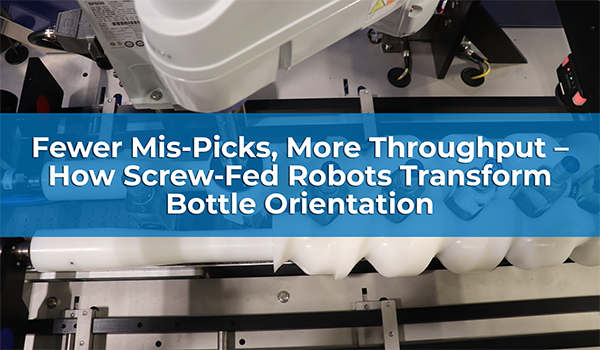
A power twist system is a custom-engineered container handling solution that combines a timing screw drive unit with a twist assembly to rotate or invert containers while maintaining positive container control. Rather than relying solely on conveyor movement or product back pressure, the system actively meters, spaces, and guides each container throughout the orientation process.
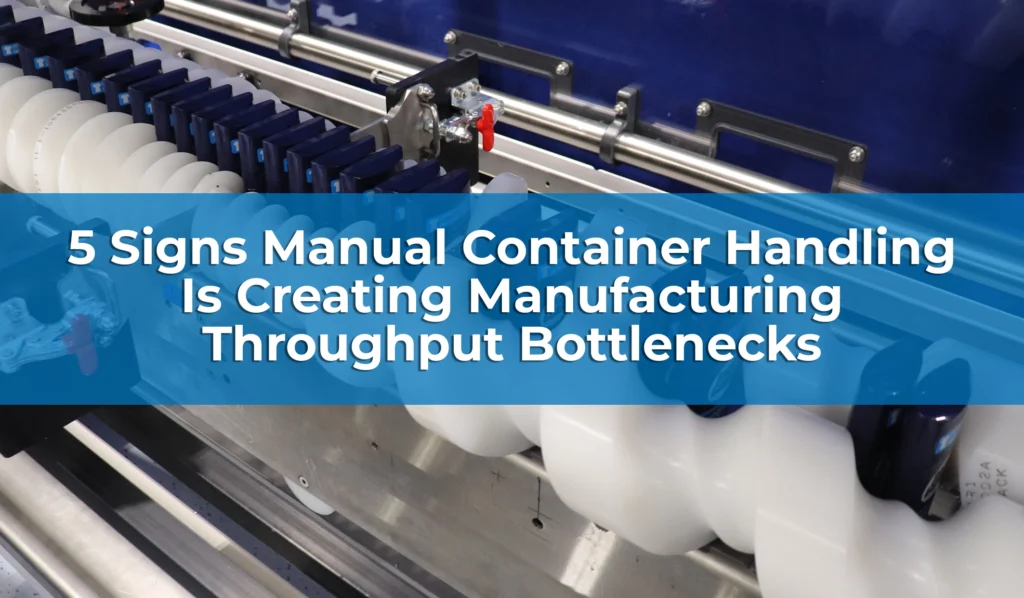
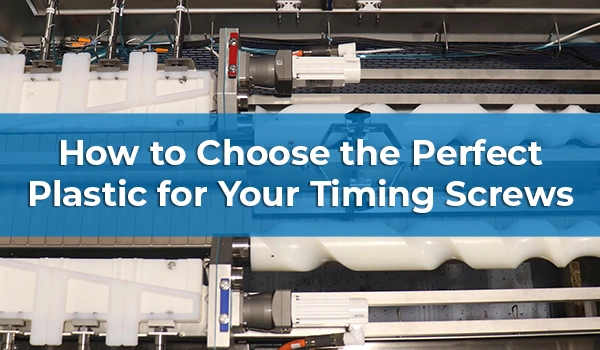
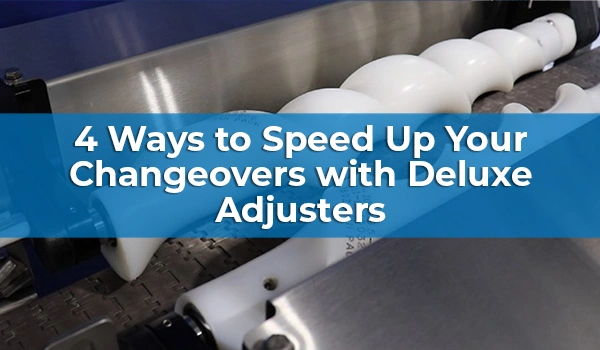
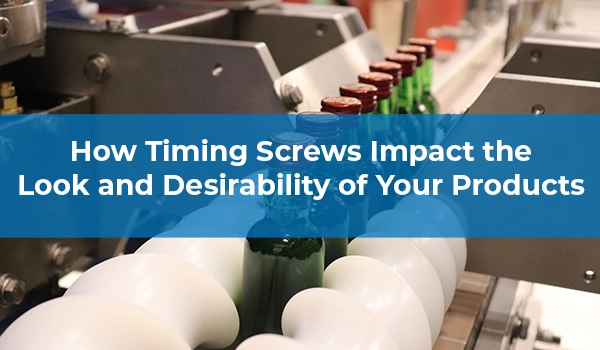
Timing screws precisely control container movement as products enter and exit the power twist assembly, helping maintain consistent spacing and stability. The twist assembly then guides each container through the required change in orientation, whether rotating it 90 degrees, inverting it 180 degrees, or returning it to its original position. Working together, these components allow containers to be reoriented without sacrificing throughput or disrupting downstream operations.
Because every application presents unique challenges, power twist systems are engineered around the specific container, production environment, and process requirements. Factors such as container geometry, material, line speed, required orientation, and downstream equipment all influence the system’s design, resulting in a solution tailored to the application rather than a one-size-fits-all approach.
Power Twists and Twist Blocks: Understanding the Difference
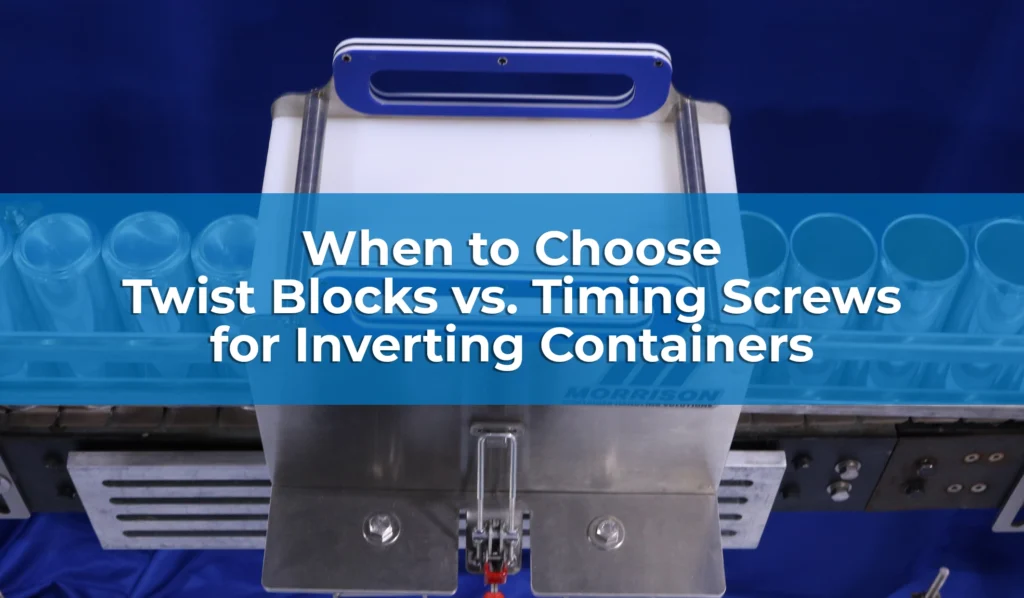
Power twist systems and twist blocks are both used to change container orientation, but they accomplish this in different ways. A twist block is a passive device that guides containers through a change in orientation, while a power twist system combines a timing screw drive unit with a custom-engineered twist assembly to maintain positive container control throughout the process.
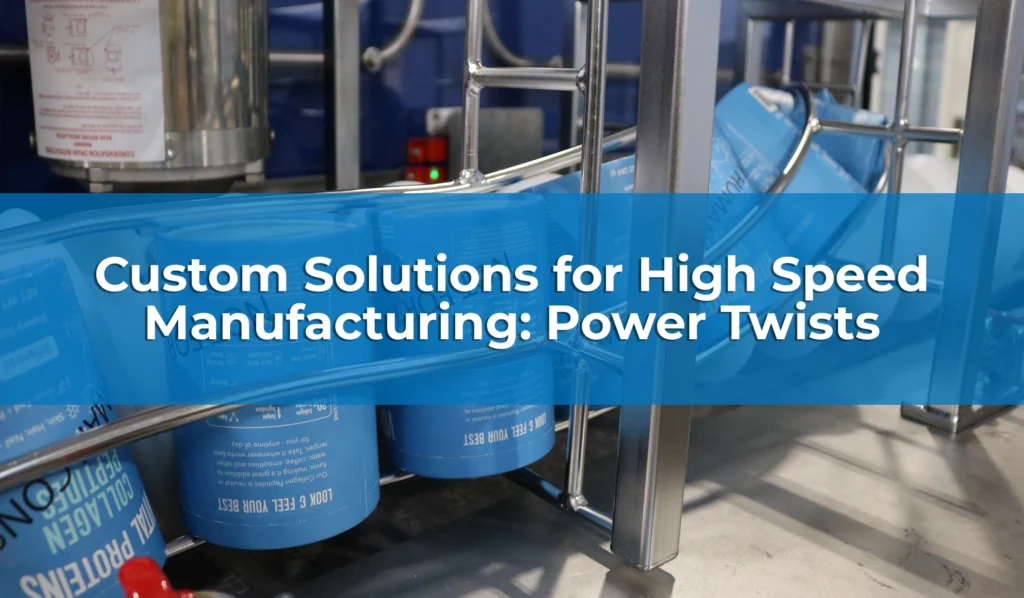
At the heart of a power twist system is a timing screw drive unit. The timing screws meter, space, and position each container as it enters and exits the twist assembly, helping maintain consistent product flow and stability. The twist assembly guides the container through the required rotation or inversion. Depending on the application, the twist assembly may incorporate stainless steel cages, custom guide components, or other engineered features designed to support the container as it changes orientation.
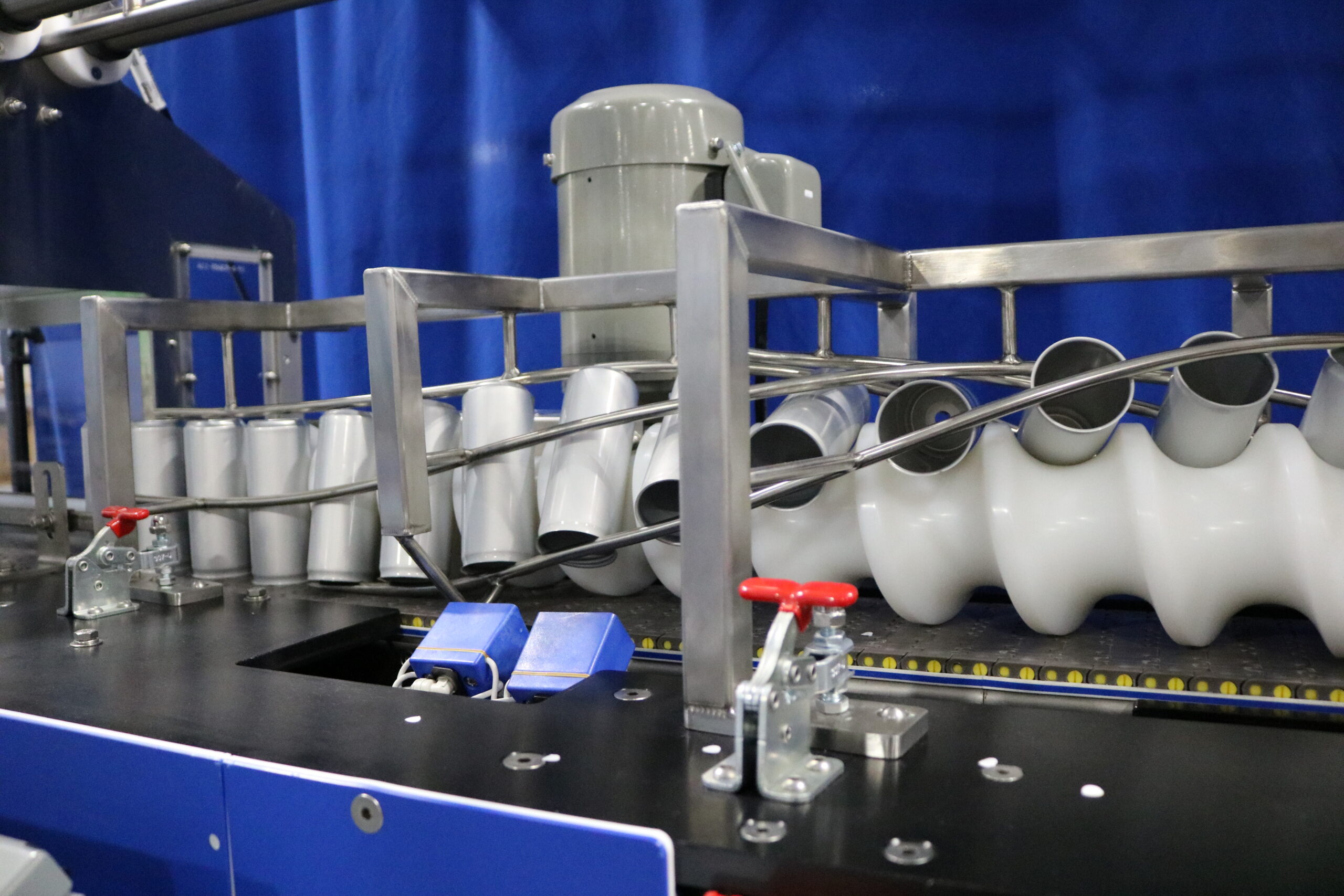
A twist block, on the other hand, is a stationary guide that relies on conveyor movement and product back pressure to move containers through its contoured surfaces. As containers travel through the twist block, they are gradually rotated or inverted to the desired orientation. Twist blocks are commonly used for applications such as rinsing, draining, drying, and inspection, where passive guidance provides sufficient control.
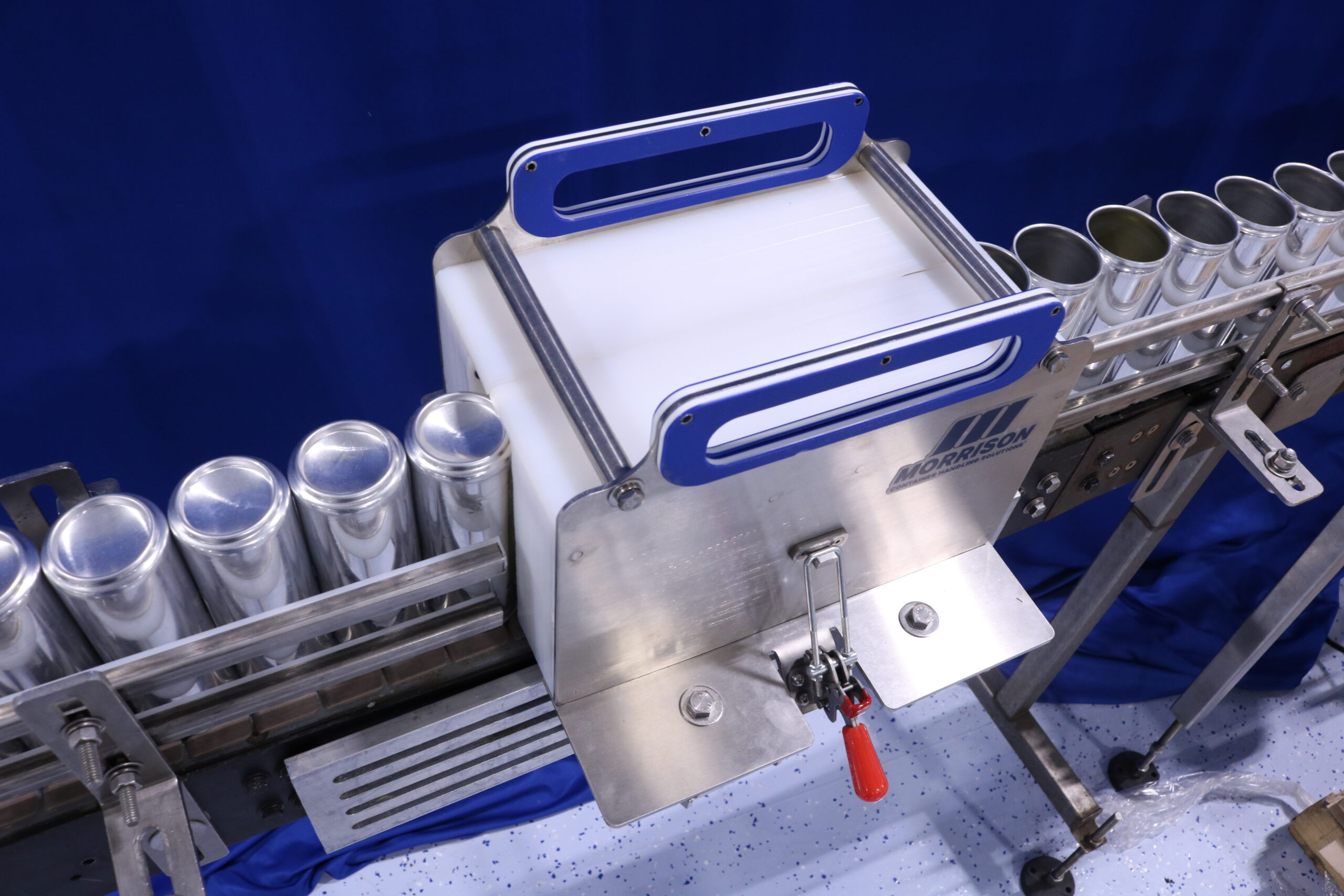
The choice between a passive twist block and a power twist system depends on the application. Factors such as production speed, container geometry, product stability, and orientation accuracy all influence whether passive guidance is sufficient or whether positive container control is required.
| Power Twist System | Twist Block |
| Complete container orientation system | Passive container orientation device |
| Combines a timing screw drive unit with a custom twist assembly | Uses a stationary, contoured guide |
| Maintains positive container control | Relies on conveyor movement and product back pressure |
| Twist assembly may incorporate stainless steel cages or other custom guide components | Twist block performs the orientation directly |
| Designed for demanding, high-speed applications | Best suited for applications where passive guidance provides sufficient control |
Applications That Require Positive Control During Orientation
Many manufacturing and packaging applications require more than simply conveying products from one machine to the next. Products may need to be inverted, reverted, or otherwise reoriented before they reach the next stage of production. Whether the goal is to prepare containers for a downstream process or create a specific product presentation, maintaining positive container control throughout the orientation process is essential for reliable operation.
Common applications for power twist systems include:
- One-up/one-down pack patterns
- Rinsing
- Cap and lid sanitation
- Code dating
- Stacking
- Case packing
- Inspection
- And other custom orientation applications
As production speeds increase, these applications become more demanding. Products have less time to change orientation while maintaining proper spacing and stability. Lightweight containers, asymmetrical products, and containers with an offset center of gravity can become increasingly difficult to manage using passive methods alone. By combining a timing screw drive unit with a custom twist assembly, a power twist system maintains positive container control throughout the orientation process, helping preserve throughput while delivering products to downstream equipment in the required orientation.
Real-world applications range from inverting and reverting jars for air rinsing to inverting cardboard tubes before filling and creating lid-to-lid stacks of applesauce cups for downstream packaging. Although each application has unique process requirements, they all rely on the same principle: maintaining positive product control while changing orientation.
How Custom Power Twists Improve Line Performance
Maintaining positive container control throughout the orientation process offers benefits that extend beyond simply changing a product’s position. By controlling product spacing, stability, and movement before, during, and after orientation, power twist systems help improve the performance of the entire production line.
Consistent product handling leads to more repeatable results. Whether inverting or reverting products, a power twist system presents each product to downstream equipment in the required orientation while helping maintain throughput. This repeatability supports reliable filling, inspection, packaging, and other automated processes. Because every application is different, power twist systems are custom engineered to meet the specific product, production speed, and process requirements. The result is a container handling solution that integrates with existing equipment while providing the positive container control needed for demanding orientation applications.
Designing a Power Twist for Your Application
No two orientation applications are exactly alike. A power twist system that works well for one product may not perform the same way with another, which is why each system is engineered around the specific requirements of the application.
The design process begins with understanding the product and the production environment. Factors such as product geometry, material, weight, center of gravity, line speed, and the required orientation all influence the design of the timing screw drive unit and twist assembly. Engineers also consider available floor space, conveyor layout, changeover requirements, and how the system will integrate with upstream and downstream equipment.
By evaluating the complete application rather than a single component, manufacturers can implement a power twist system that delivers reliable orientation, maintains positive container control, and supports long-term production goals.
Choosing the Right Orientation Solution
Every orientation application presents unique challenges. Product geometry, production speed, process requirements, and downstream equipment all influence the best approach. While passive twist blocks may be well suited for some applications, others require the positive container control provided by a custom power twist system.
By combining timing screw drive units with custom twist assemblies, power twist systems help manufacturers reliably invert, revert, and position products while maintaining spacing, stability, and throughput. The result is a solution engineered around the application—helping improve performance not only during orientation, but across the entire production line.
Need to change product orientation as part of your manufacturing process?
Request a quote to discuss your application with our engineering team.