You’ve optimized production lines and invested in upstream automation, yet hitting output targets still feels harder than it should.
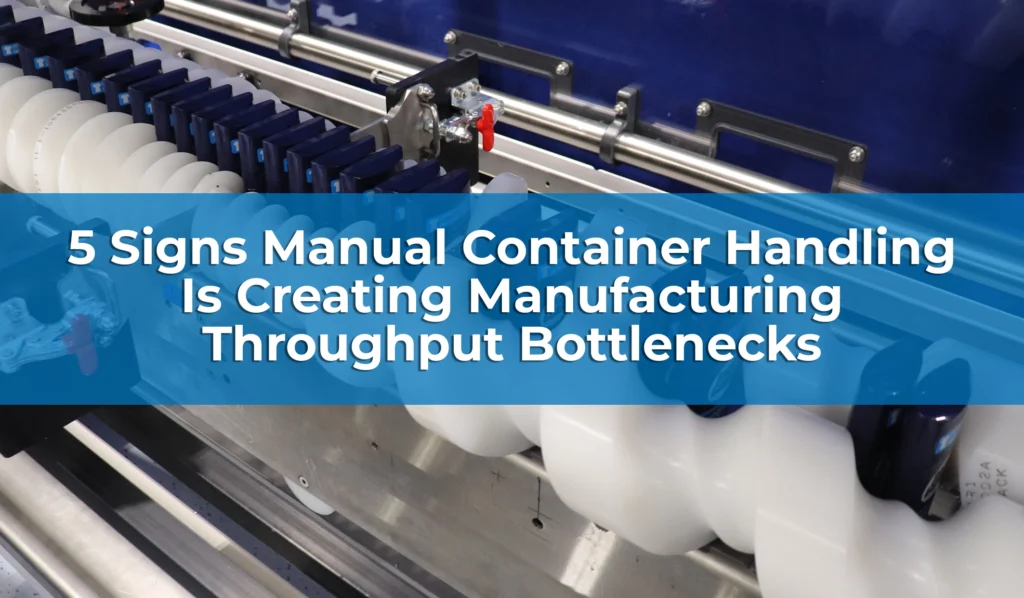
The issue isn’t always your equipment. In many plants, throughput is constrained by material flow—especially manual container handling, an often-overlooked bottleneck that quietly limits performance.
Here are five signs manufacturing throughput bottlenecks may be holding your container handling process back.
Sign #1: Production Line Delays Are Becoming a Daily Occurrence
What it looks like:
- Operators waiting on container swaps
- Forklift delays during shift changes
- Bottlenecks at staging areas
- “Micro-stoppages” that add up
Manual container handling often creates production line delays that feel minor in the moment but compound over time. When containers must be manually moved, repositioned, or exchanged, the production line pauses while material flow catches up. These interruptions reduce overall equipment effectiveness (OEE), pull labor away from value-added work, and introduce inconsistency across shifts. What appears to be a scheduling or staffing issue may actually be a material handling bottleneck restricting throughput.
Questions to ask:
How frequently does container movement interrupt your production flow, and how much uptime is lost each shift because of it?
Sign #2: Material Handling Bottlenecks Are Consuming Skilled Labor
What it looks like:
- Operators manually tilting or repositioning containers
- Maintenance assisting with container jams
- Supervisors reassigning labor to “help keep things moving”
Material handling bottlenecks often show up as labor inefficiency. When manual container handling requires operators to move, flip, or stage containers throughout the shift, skilled labor is pulled away from core production responsibilities. Instead of running equipment and maintaining output, experienced employees spend time on non-value-added tasks.
The result: labor costs increase without a corresponding gain in throughput. Over time, repetitive handling also contributes to fatigue, which can slow cycle times and increase the likelihood of errors.
Question to ask:
How much of your skilled labor’s time is spent handling containers instead of running production equipment?
Sign #3: Plant Floor Congestion and WIP Buildup Are Limiting Production Flow
What it looks like:
- Overflow containers stacked near work cells
- Large buffer areas between operations
- Forklift traffic congestion throughout the plant
Plant floor congestion is often a visible symptom of deeper production flow problems. When manual container handling requires extra staging space, containers begin accumulating between process steps. Work-in-progress (WIP) builds, travel distances increase, and forklift traffic becomes more frequent and disruptive.
While additional inventory on the floor can sometimes signal growth, it more often reflects a material flow constraint. As staging and buffer zones expand, usable production space shrinks. Layout optimization, safety improvements, and future line expansion become more difficult.
Question to ask:
Is the space consumed by container staging supporting production or compensating for inefficient material flow?
Sign #4: Safety Incidents and Near-Misses Are Increasing Around Container Handling
What it looks like:
- Strain complaints from lifting or tilting containers
- Repetitive motion concerns
- Downtime tied to safety investigations or slowdowns
Frequent safety incidents around container handling are more than isolated HR concerns; they’re operational warning signs. Manual lifting, repositioning, and staging of containers increase the risk of strain injuries and repetitive stress.
Each incident reduces uptime, whether through injury-related absenteeism, temporary reassignments, or production pauses during safety reviews. Over time, safety-driven slowdowns can become normalized, quietly limiting throughput and increasing labor variability across shifts.
Question to ask:
Has container handling evolved from a routine task into an ongoing safety management issue affecting uptime?
Sign #5: Throughput Plateaus Despite Higher Demand and Added Labor
What it looks like:
- Production can’t scale without adding labor
- Additional shifts fail to produce proportional output gains
- Backlogs forming between process steps
- Output variability across shifts
A throughput plateau often signals a hidden manufacturing capacity constraint. When manual container handling determines how quickly materials can be moved, staged, or exchanged, it creates a fixed ceiling on production output. Equipment may be capable of running faster, and demand may justify higher volume, but material flow cannot keep pace.
In response, many facilities add labor. However, increasing headcount or adding shifts typically delivers only incremental improvement because the underlying material handling bottleneck remains in place. Over time, container movement becomes the true constraint limiting scalability rather than the production equipment itself.
Question to ask:
If increasing labor is the primary way to increase output, is your process truly scalable, or is manual container handling setting the limit?
The Common Thread Behind Manufacturing Throughput Bottlenecks
Production interruptions, labor inefficiency, space constraints, safety incidents, and limited scalability may seem like separate challenges—but often share a common root cause: manual container handling restricting material flow.
When containers must be manually moved, staged, tilted, or exchanged, small inefficiencies compound across operations, creating a system-level bottleneck. What looks like staffing, performance, or layout issues is often a process constraint.
This isn’t an employee problem—it’s a design problem. Until container flow is addressed, throughput will remain limited regardless of equipment or workforce performance.
Not Sure Where Your Throughput Constraint Is?
Many manufacturing throughput bottlenecks originate in material handling bottlenecks rather than production equipment limitations. A structured evaluation can help determine whether manual container handling is limiting output.
If you would like a second set of eyes on your current process, our team can review your container flow and identify potential constraints.
Schedule a throughput review conversation to assess where material handling may be impacting performance.
Contact Info:
- Phone: +1(708) 756-6660
- Email: info@morrison-chs.com